Entrepreneurship in Cameroon in 2026: challenges, support and levers
Cameroon's business landscape has never been so dense, yet financing, formalising and growing a business is still an obstacle course. This special issue, written with the Muslim entrepreneur in mind, takes stock: the key figures, the challenges of the moment, the support schemes worth knowing and the levers opening up for you, from Islamic finance to zakat and waqf.
The ecosystem in numbers
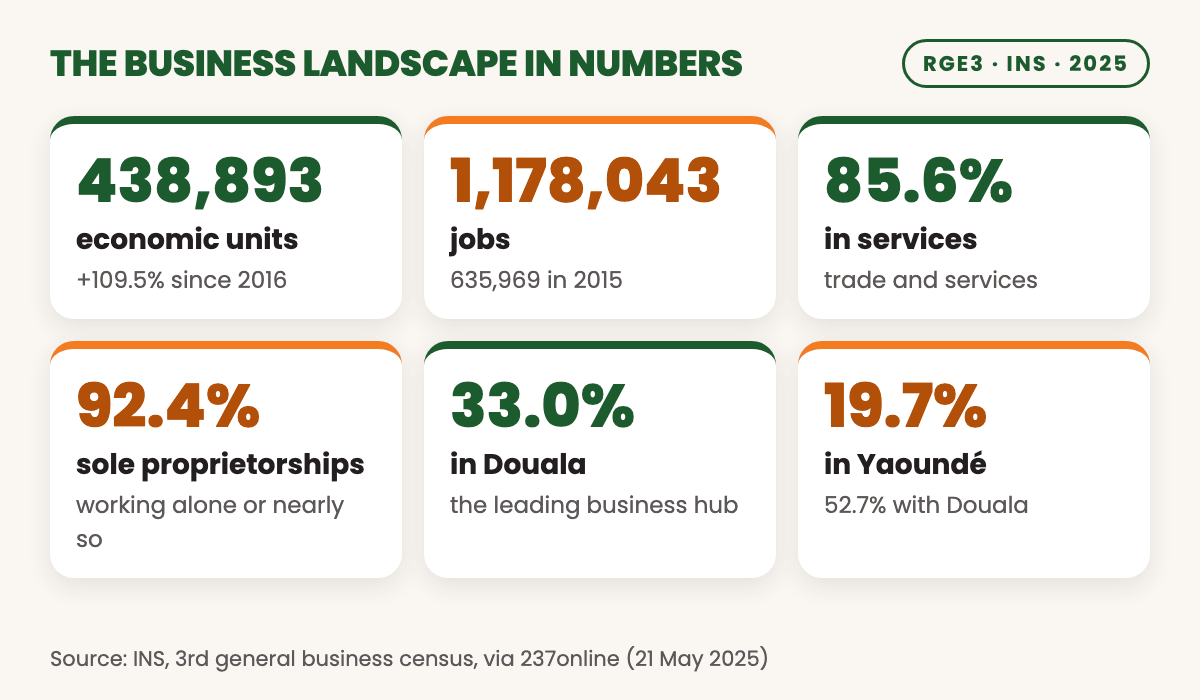
The third general business census (RGE3), carried out by the National Institute of Statistics (INS) and published in 2025, gives the most recent picture of Cameroon's economic fabric.
Source : INS (RGE3), as reported by 237online, 21 May 2025
438,893 economic units were counted, 109.5% more than in 2016 (part of the rise reflects a wider census scope). They support 1,178,043 jobs, against 635,969 in 2015.
Mostly trade and services, run as sole proprietorships
Source : INS (RGE3), as reported by 237online
The services sector accounts for 85.6% of economic units, and 92.4% of them are sole proprietorships: the vast majority of entrepreneurs work alone, or nearly so.
Two cities hold more than half of the activity
Source : INS (RGE3), as reported by 237online
Douala accounts for 33.0% of economic units and Yaoundé for 19.7%, that is 52.7% between them. The West region follows with 9.7%. Starting up outside the main cities remains a lonelier bet.
Training, an open front
Source : INS (RGE3), as reported by 237online
Among business owners, 12% have a higher-education qualification and 48.4% hold the primary school certificate (FSLC). The census also points to a high degree of informality.
The challenges of the moment
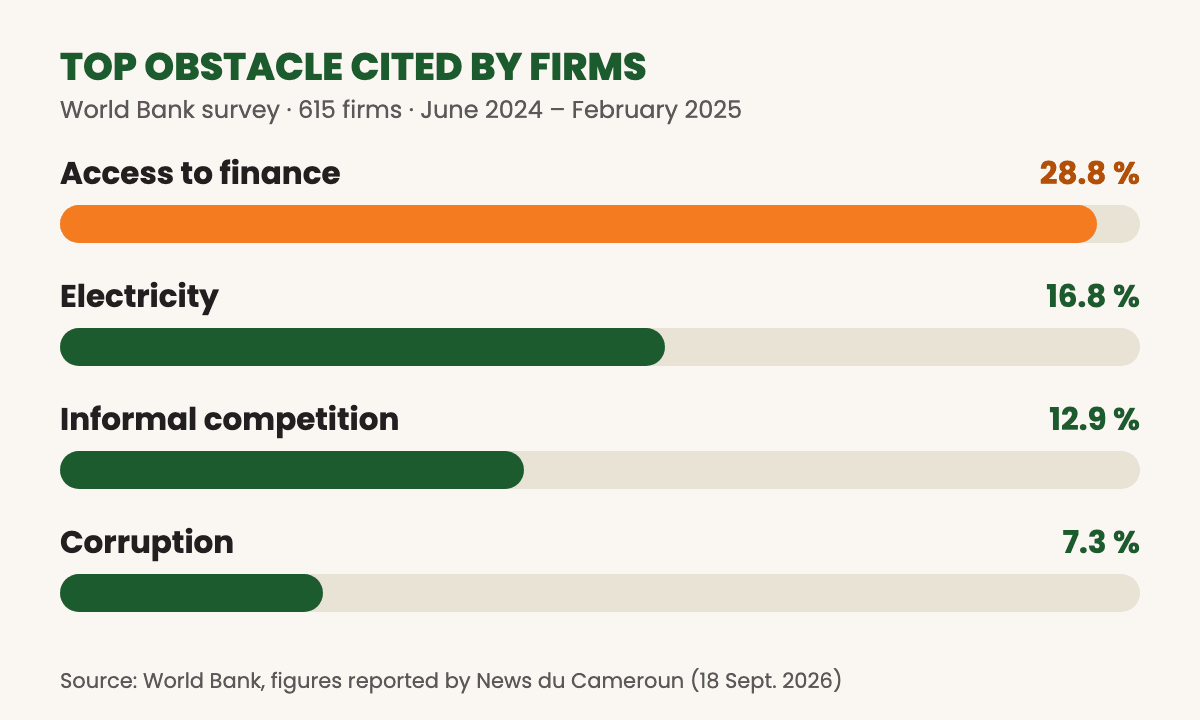
Asked about their obstacles, business owners almost always name the same ones. Here they are, with what the available figures say.
Source : World Bank, via News du Cameroun, 18 September 2026
In the World Bank survey carried out between June 2024 and February 2025 among 615 firms, access to finance ranks first among obstacles (28.8%), ahead of electricity (16.8%), informal competition (12.9%) and corruption (7.3%).
Source : MINPMEESA 2024 statistical yearbook, via Ecomatin (14 May 2025)
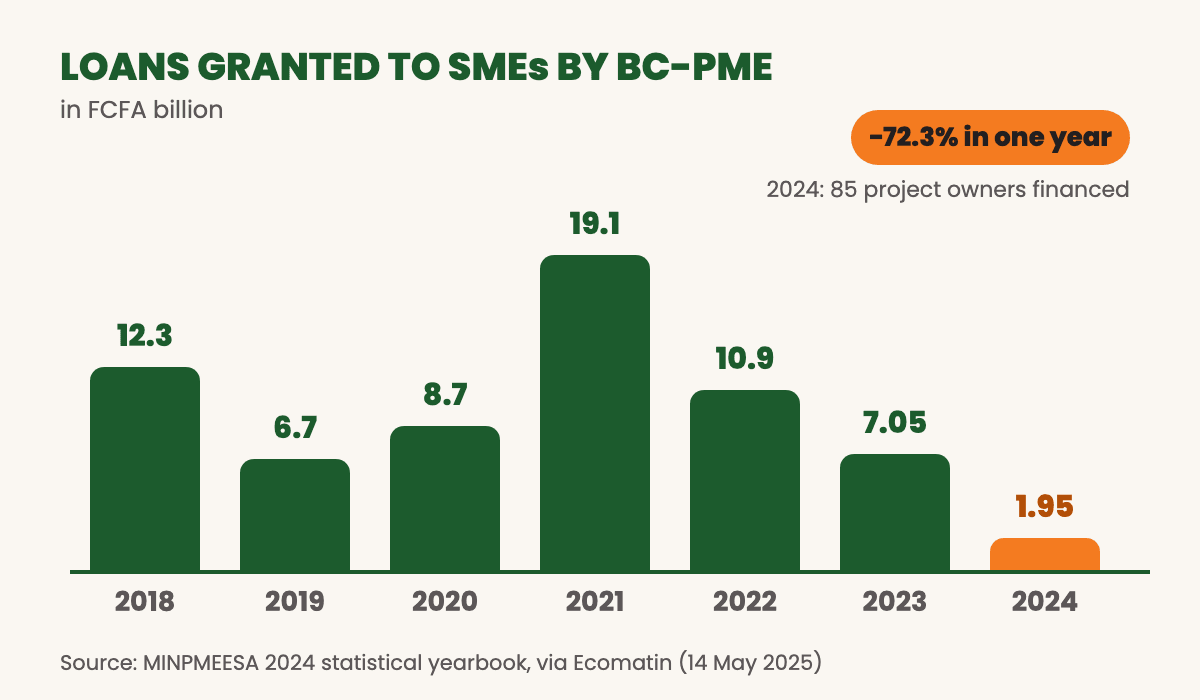
The Cameroon SME Bank (BC-PME) granted FCFA 1.95 billion in loans to 85 project owners in 2024 (8 of them women), 72.3% less than a year earlier and the lowest level in seven years. It had received 127 applications worth FCFA 3.24 billion; 42 projects were turned down, notably for insufficient solvency, profitability or business plans. A FCFA 1.5 billion agreement signed on 4 December 2025 with the SME ministry is meant to relaunch subsidised loans for agropastoral and fisheries value chains.
Costly, unreliable power
Source : World Bank, via News du Cameroun
Access to electricity is the second most cited obstacle (16.8%), far ahead of administrative hurdles. For a workshop, a bakery or a processing unit, every outage is paid for in lost output.
Source : World Bank; PwC, via the Africarrieres guide (2026)
Informal businesses remain numerous, and informal competition is the main obstacle for 12.9% of firms. For the entrepreneur who formalises, the tax burden (33% corporate income tax, 19.25% VAT, council surcharges included) weighs against those who avoid it.
Ecosystem players and the Nkafu Policy Institute are calling for a Startup Act: a clear status, simpler registration, tax relief, access to funding and regulatory sandboxes. To our knowledge, no text had been enacted at the time of writing.
The Ministry of Finance acknowledges it itself: the sector remains marginal, with low penetration in microfinance and insurance. It launched a national awareness campaign on 22 December 2025.
Press review
Five recent stories shaping the landscape (summarised by us, with their sources).
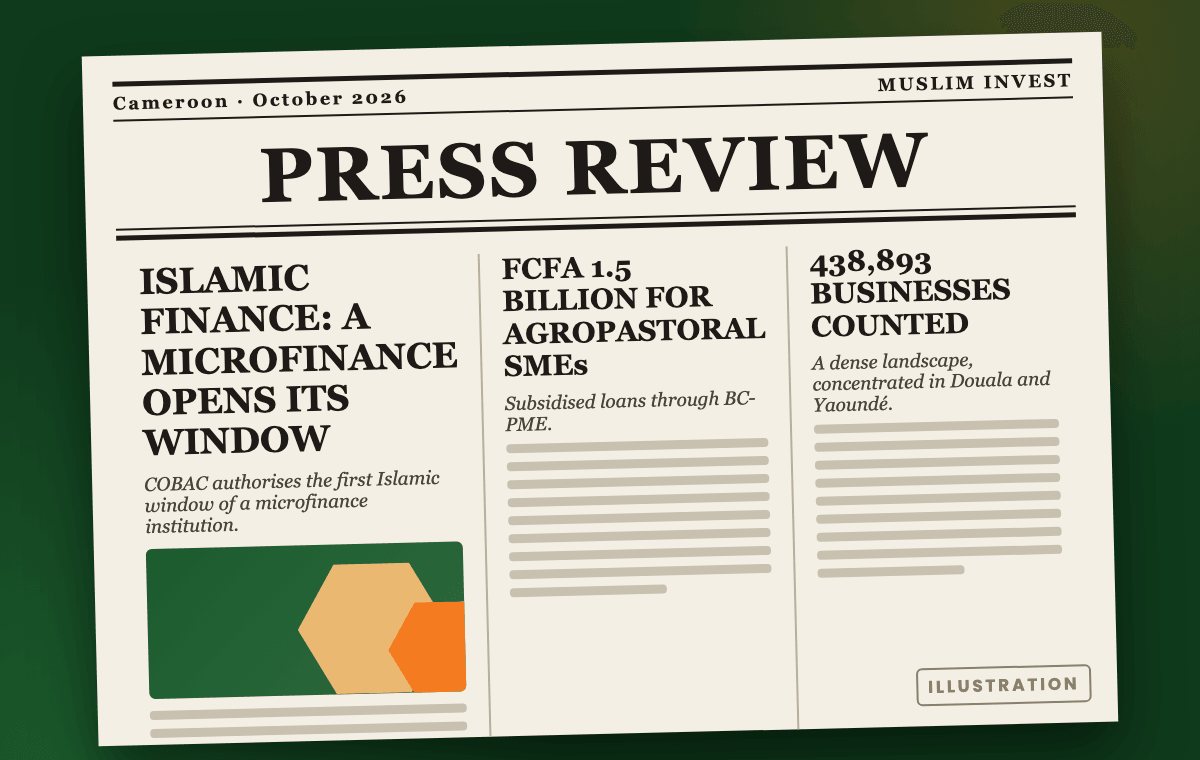
Original illustration, not taken from a newspaper.
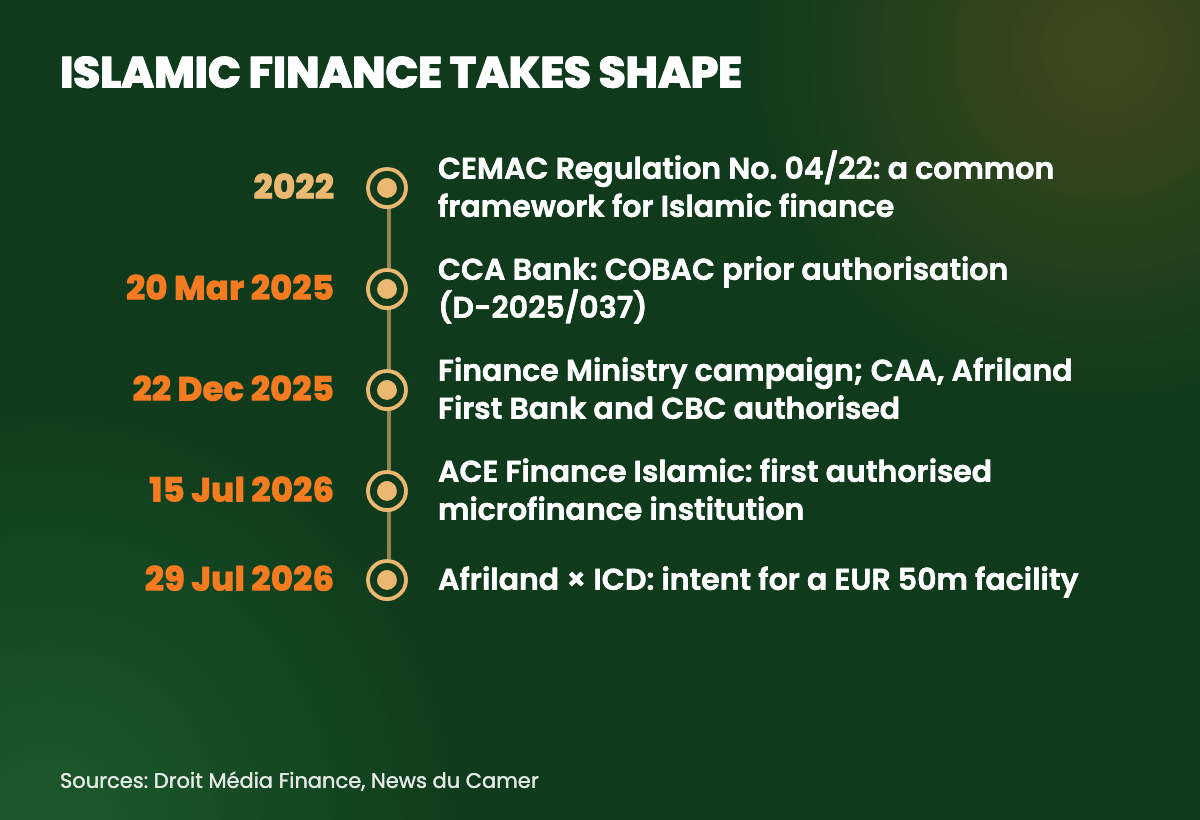
Launched on 22 December 2025 in Yaoundé, it presents Islamic finance as an ethical, inclusive and complementary financing lever. Three banks (CAA, Afriland First Bank and CBC) hold COBAC's prior authorisation to open Islamic windows.
Under COBAC decision D-2026/231 (session of 15 July 2026), ACE Finance was authorised to open "ACE Finance Islamic", presented as the first Cameroonian microfinance institution to do so.
A declaration of intent was signed on 29 July 2026 in Baku to structure, with the Islamic Corporation for the Development of the Private Sector (IsDB Group), a Sharia-compliant financing of about FCFA 32.8 billion for SMEs. It is an intention, not yet a finalised loan.
The SME ministry transferred FCFA 1.5 billion to BC-PME (agreement of 4 December 2025) to finance, at subsidised rates, processing units and cooperatives under the import-substitution plan.
438,893 economic units counted, more than half of them in Douala and Yaoundé: a dynamic market, but a very concentrated one.
Support: who can help you?
The schemes below are cited by the Startup Cameroon directory, guides and the press. Conditions, amounts and calendars change: check them with each organisation before applying.
The SME Promotion Agency (APME), under the SME ministry, offers technical assistance, help with access to finance and annual grants of up to FCFA 10 million. The ministry has also launched a pilot business incubator in Édéa.
Alongside BC-PME, guides cite the National Employment Fund (FNE), PAJER-U for young people, FOGAPE (credit guarantee) and Crédit Foncier du Cameroun (SME loans). A five-year tax exemption is presented for agritech, cleantech, fintech and edtech start-ups.
The Business Plan Competition targets 2,000 emerging entrepreneurs, with grants of USD 10,000 to 20,000, coaching and help with formalisation. The Economic Inclusion of Youth programme (EIY) targets 65,000 unemployed urban young people: management training, coaching and a USD 500 grant.
Open to Africans aged 18 and over with an idea or a business less than three years old, the programme provides non-refundable seed capital (up to USD 5,000), a twelve-week training course and mentoring. The 2026 call ran from 1 January to 1 March: watch for the next one on tefconnect.com.
For start-ups: Digital Africa Fuze (up to EUR 100,000 at pre-seed), the Bridge Fund (EUR 175,000 to 600,000 at seed) and Talent4Startups, delivered in Cameroon by ActivSpaces (ten-week training, grants, job placement).
Ecobank Fintech Challenge (USD 50,000), MTN Innovation Challenge, Seedstars Cameroon, the Pierre Castel Prize for agri-food (EUR 25,000 to 100,000), Cartier Women's Initiative for women entrepreneurs (USD 100,000): winning a competition also means winning visibility.
ActivSpaces (Douala, Buea), Village Startup (Yaoundé), Orange Fab and others offer coworking, incubation lasting a few months and networking. Expect prices from a few tens of thousands of FCFA per month depending on the offer.
Islamic finance: a lever taking shape
Since Regulation No. 04/22/CEMAC/UMAC/COBAC was adopted in 2022, banks and microfinance institutions in the CEMAC zone can offer Sharia-compliant products, under the supervision of COBAC and a compliance committee.
CAA, Afriland First Bank and CBC hold COBAC's prior authorisation for their Islamic windows (Ministry of Finance, December 2025). CCA Bank received its own through decision D-2025/037 of 20 March 2025. ACE Finance Islamic is the first authorised microfinance institution (July 2026). The list moves fast: always ask for the compliance certificate.
ICD, part of the Islamic Development Bank Group, has already opened several lines to Afriland First Bank since 2016. The July 2026 declaration of intent targets a new EUR 50 million facility for agriculture, agro-industry, health, manufacturing and transport.
The Finance Ministry's workshop recommends a specific community-wide tax regime, a framework for Islamic insurance (takaful) at CIMA level, more legal certainty and incentives for investors.
Seven levers to flourish
Beyond the counters, here is what can really make a difference for a Muslim entrepreneur.
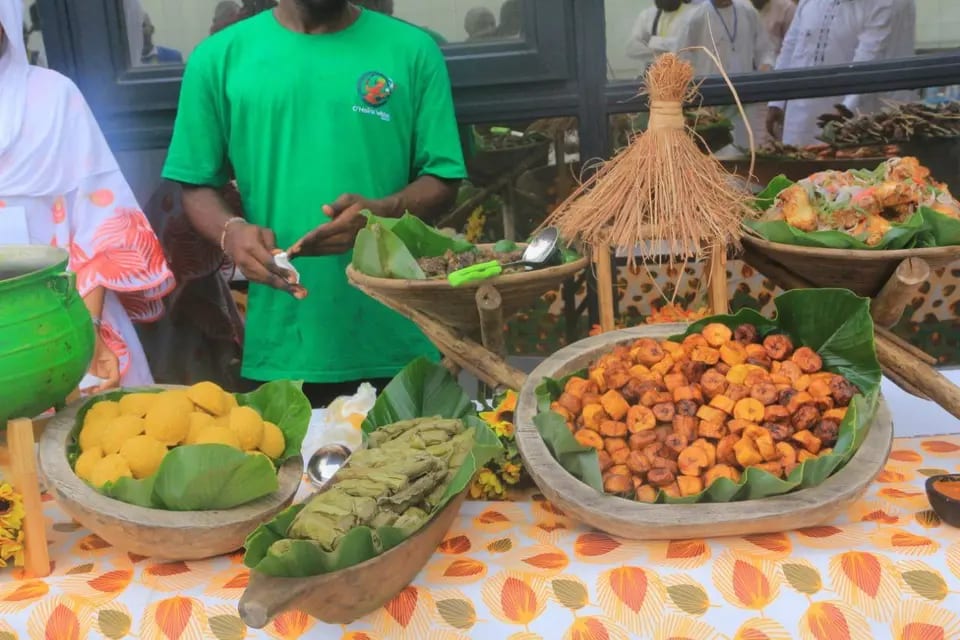
MIBS25: entrepreneurs' products on show.
1. Make ethics a competitive advantage
Clear prices, written contracts, payments honoured: trust is built, and where informality rules, it becomes capital.
2. Formalise to unlock funding
Registration, bookkeeping, a business account: this is the condition for access to guarantees, public programmes, bank lines (Islamic ones included) and large companies' supply chains. The CFCE one-stop shop handles start-up formalities.
3. Partner rather than borrow
Mudaraba and musharaka rest on risk sharing: a trusted partner brings capital and shares losses as well as gains. Ethical business angels and associations among community members are relays still to be structured.
Local bodies collect zakat, donations and waqf, such as Beitul Zakat in Douala (since 2011). In September 2023, the Ministry of the Economy and the Islamic Development Bank held a workshop on waqf as a development financing tool. For zakat, always consult a scholar on the categories of beneficiaries.
5. Train and get coached
Incubators, competitions, mentoring: the schemes in the previous section and the MIBS26 masterclasses let you test, correct and be challenged before investing.
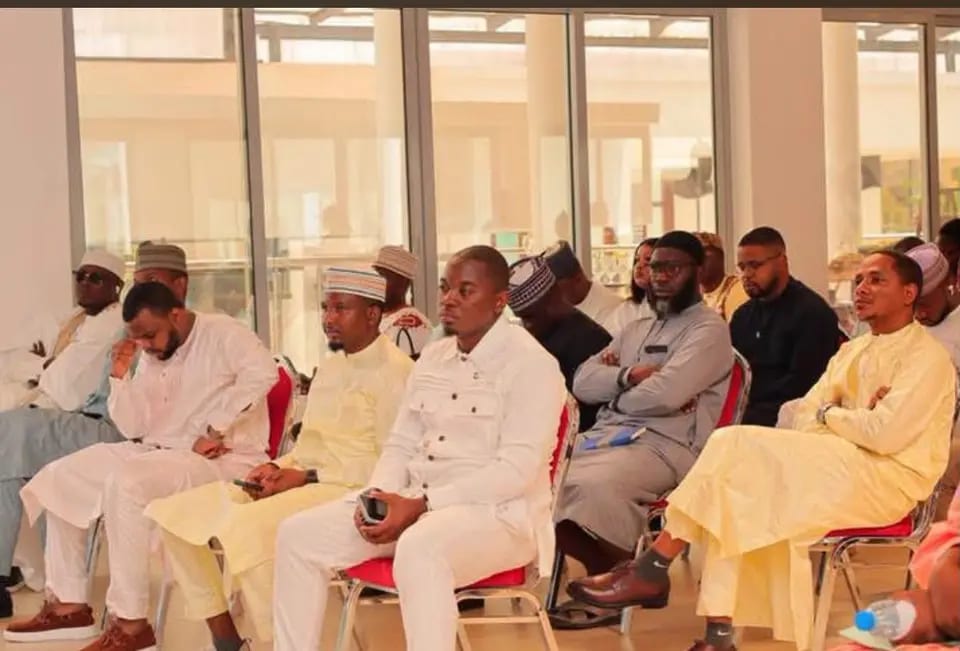
The Cameroon Muslim Exhibition (10th edition in 2024, in Douala and Yaoundé) put entrepreneurship and spirituality at the heart of its programme. Events like MIBS26 are where you meet customers, partners and funders.
7. Digitise payments and visibility
Mobile Money, a web page, WhatsApp Business: being reachable and payable at any hour widens the customer base. These are the tools Muslim Invest uses for MIBS26 registrations.
Your five-step action plan
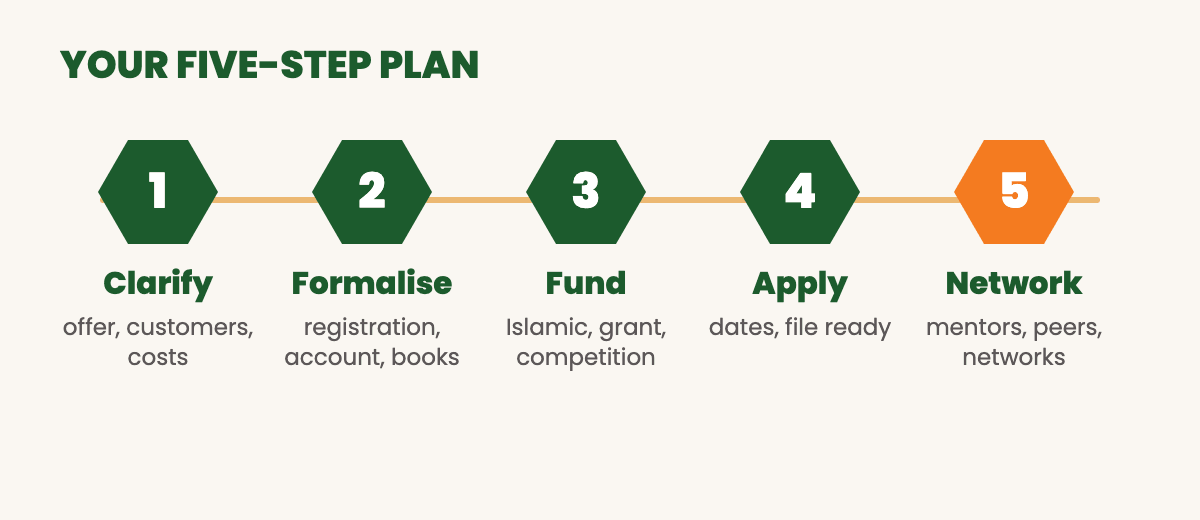
1. Clarify
Write down on one page your offer, customers, costs and break-even point. A funder reads the numbers first.
2. Formalise
Register the business, open a business account, keep simple books.
3. Choose your funding
Self-funding, Islamic window, grant or competition: compare the total cost and the conditions.
4. Apply
Note when calls open (TEF, competitions, public programmes) and prepare your file in advance.
5. Build your network
Mentors, peers, networks: join the community and attend events that move your project forward.
On the agenda: MIBS26
The Muslim Invest Business Summit takes place from 18 to 20 December 2026 in Douala: masterclasses, conferences, workshops, exhibition and networking. Standard Pass at FCFA 30,000, Prestige Pass at FCFA 80,000 (two admissions). Registration and Mobile Money payment are done online.
Information drawn from the public sources cited above, consulted in October 2026. Check conditions, amounts and dates with the organisations before taking any step. This issue is not financial, legal or religious advice.